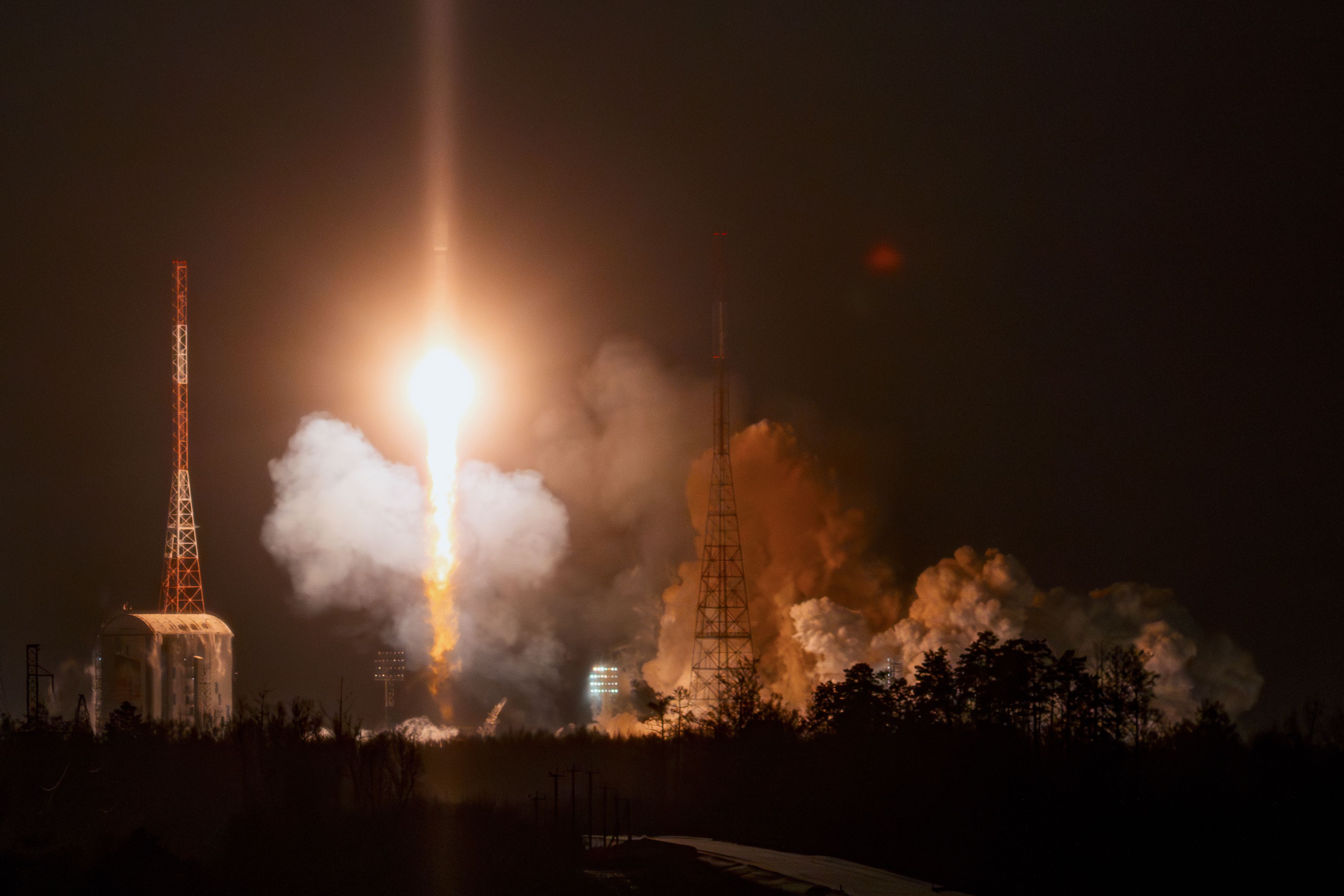
Today, on the 67th anniversary of the Earth's first artificial satellite launch, Geoscan excited to announce the start of new space campaign! In 2022, Geoscan-Edelveisdelivered into orbit the names of everyone who wished to participate. This time, you can send not only your name but also an image into space.
For 2025, the launch of the school small satellite 239Alferov is planned. The satellite is being developed by Geoscan for Presidential Physics and Mathematics Lyceum No. 239 and Zh.I. Alferov Physics and Technology School as part of the Space-π project. A digital storage device will be installed on the satellite containing the names, drawings, and photos submitted by the participants. Additionally, the satellite's management team will select the 100 most interesting drawings, which after the launch will be transmitted to Earth in the amateur radio frequency band.
The 239Alferov satellite will be launched using the Soyuz-2.1b rocket and the Fregat upper stage from the Vostochny Cosmodrome. The payload will include a gamma-ray burst detector and a VERA ablative pulsed plasma engine.
The campaign will run until April 15, 2025. To participate, you need to fill out a form on website. After that, you will receive an email with a confirmation of registration in the form of a ticket or an A4 certificate.
Stay tuned for updates on the launch of the 239Alferov satellite and the campaign results!
Monitoring near-Earth space, tracking the dynamics of Earth’s radiation belts, and forecasting space weather are tasks that instruments in orbit, built in various countries, are addressing today. A team from the Laboratory of Geospace Research at NRNU MEPhI – staff, students, and schoolchildren – is developing its own version of such an instrument
Amateur Radio Broadcasting Event:
from September 11 to 20, 2026, amateur radio digital broadcasts of postcards will be conducted almost worldwide from the Geoscan-2, Geoscan-4, and Geoscan-5 satellites using Geoscan’s own protocol
The Svetlana spectrometer will enable simultaneous detection of energetic electron fluxes from the radiation belt and atmospheric glow within the auroral oval directly aboard a CubeSat