Young Scientists of NRNU MEPHI Are Developing an Instrument for Studying Auroras
The Svetlana spectrometer will enable simultaneous detection of energetic electron fluxes from the radiation belt and atmospheric glow within the auroral oval directly aboard a CubeSat
The GeoSpace Research Laboratory of NRNU MEPHI is returning to active scientific work. The collective, comprising experienced specialists, students, and schoolchildren, is currently focused on building advanced scientific instrumentation for CubeSat-class small spacecraft.
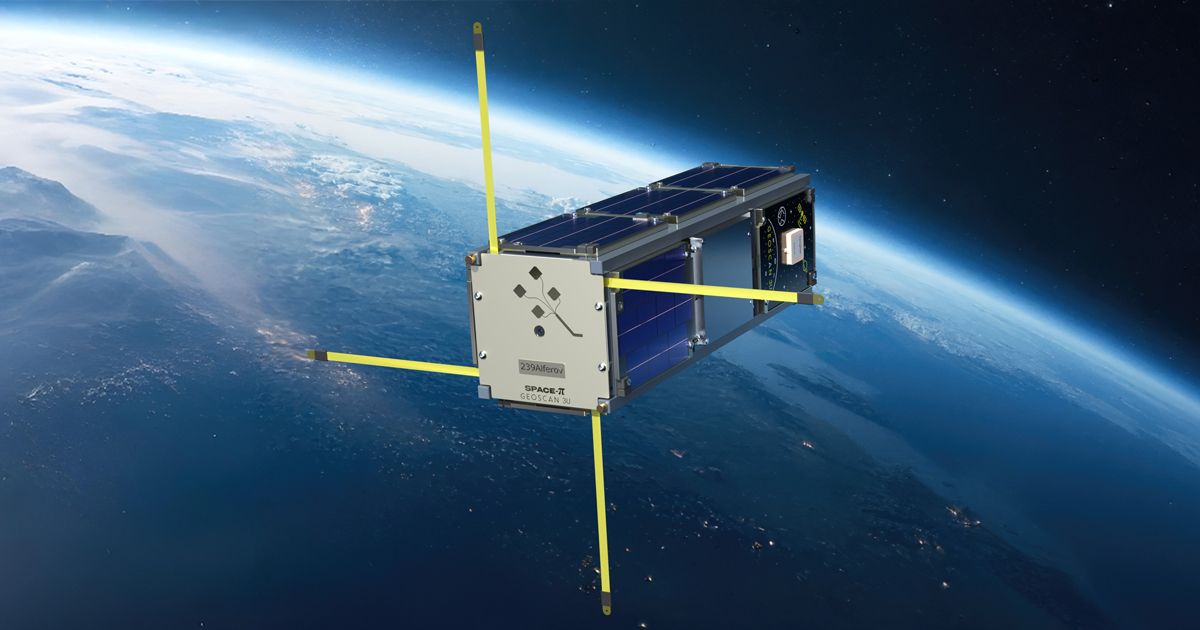
One of the laboratory's projects is the development of the Svetlana scintillation multilayer spectrometer, designed to study auroras — one of the most beautiful and physically complex phenomena in near-Earth space. The primary task of the scientific instrument, to be installed aboard a CubeSat 3U spacecraft by the Geoscan company, is the joint detection of energetic electron fluxes from Earth's outer radiation belt and atmospheric glow within the auroral oval.
During geomagnetic storms, particles with energies ranging from tens of keV to about ten MeV penetrate the ionosphere, causing ionization and excitation of atoms; the subsequent relaxation of these excited states produces the emission we observe as auroras (including the familiar northern lights, since we live in the Northern Hemisphere). Beyond the visual splendor of the phenomenon, studying the underlying processes in real time may yield substantial scientific results — for instance, establishing direct quantitative relationships between particle energy and emission intensity, which is crucial for understanding the physics of magnetosphere–atmosphere interaction.
Structurally, the instrument is a multilayer spectrometer composed of modules with double planes filled with scintillator strips — this assembly bears its own name, TwinPad. This architecture enables the detection of particles across a wide energy range with high temporal resolution directly aboard a CubeSat nanosatellite, while also standardizing the device for use in future missions.
TwinPad module. The light-gray strips are scintillators, in which flashes of light are produced (much like in Earth's atmosphere) by the passage of charged particles — in our case, electrons. The green-colored boards are the electronics that perform the initial processing of signals from the silicon photomultipliers (shown in raspberry color), which convert the light signal into an electrical pulse
To enhance measurement reliability, the instrument incorporates an anti-coincidence system that effectively suppresses background events caused by galactic cosmic rays and secondary particles unrelated to the precipitation process under study. This makes it possible to extract the useful signal even in the challenging radiation environment of orbit.
Working side by side with the laboratory's staff and students on the TwinPad modules are schoolchildren from several educational institutions. The students are engaged in refining the mechanical components and assembling the detectors.
Another group of school students has joined another important task — developing the instrument's electronic circuits and programming its operational algorithms on an FPGA and a microcontroller. This gives the young researchers invaluable hands-on experience with state-of-the-art onboard digital electronics.
The team of the GeoSpace Research Laboratory notes that the opportunity to conduct full-fledged observations aboard a CubeSat-class spacecraft is an exciting and ambitious challenge. The staff have dozens of experiments behind them, conducted aboard artificial Earth satellites, including the Salyut and Mir orbital stations and the ISS. Among the brightest pages of their history is participation in the PAMELA experiment, whose results were recognized by the scientific community in 2008 as one of humanity's most significant achievements, alongside the launch of the Large Hadron Collider.
“We enthusiastically embraced the idea of creating a series of small scientific instruments, including Svetlana, and we take great pleasure in passing on our knowledge and many years of experience to the younger generation. We are confident that our joint work on this instrument will both become an important step in training new personnel for the domestic space industry and yield new scientific data,” added a member of the GeoSpace Research Laboratory.
The project is implemented within the framework of the Space-π scientific and educational program of the Innovation Promotion Foundation, with support from the Federal Project “Personnel for Space” of the Russian Ministry of Science and Higher Education.
Amateur Radio Broadcasting Event:
from September 11 to 20, 2026, amateur radio digital broadcasts of postcards will be conducted almost worldwide from the Geoscan-2, Geoscan-4, and Geoscan-5 satellites using Geoscan’s own protocol
In Moscow, the Geoscan company gathered schoolchildren, students, specialists and space enthusiasts to discuss the present and future of space exploration